

Adolescents and transition-aged youth experience substance use, mental health challenges, family dynamics, and developmental milestones differently than adults. Yet for many years, providers relied on treatment frameworks that were largely adapted from adult models of care.
The recently released ASAM Criteria for Adolescents and Transition-Aged Youth (ATAY) changes that. Developed as a dedicated companion to the ASAM Criteria 4th Edition, this new volume provides a framework specifically designed to help providers assess, engage, and support adolescents and transition-aged youth with substance use and co-occurring behavioral health needs.
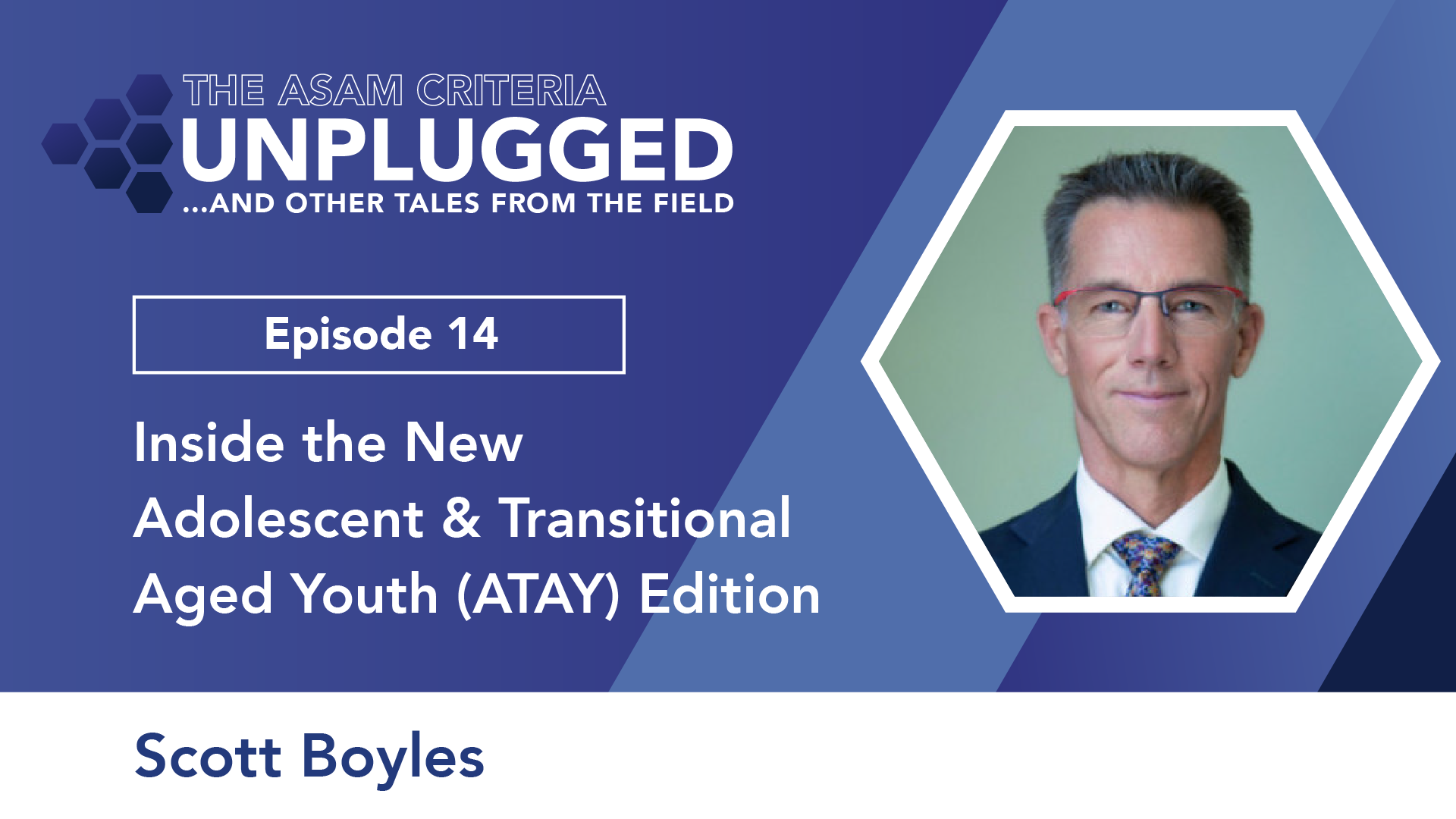
In a recent ASAM Criteria Unplugged webinar, Scott Boyles, Senior National Training Director at Train for Change Inc., provided a high-level look at key updates and emerging themes within the new ATAY Edition.
Here are four key takeaways from the discussion.
Takeaway 1: Development is central to adolescent care.
One of the most significant shifts in the ATAY volume is the emphasis on development. While previous editions recognized the importance of developmentally appropriate care, the new adolescent volume provides much more detailed guidance on what this means in practice.
As Scott explained, "The fourth edition of the adolescent criteria... gives us much more significant details as far as what developmentally appropriate looks like."
For providers, this means looking beyond substance use symptoms alone and considering factors such as cognitive development, emotional regulation, social influences, identity formation, and decision-making skills. These considerations can allow for treatment approaches that reflect individual differences in development and that shape engagement strategies, treatment planning, and service delivery.
Takeaway 2: Family-driven and youth-guided care matters.
Another defining feature of the ATAY volume is the emphasis on family involvement for effective youth treatment. As Scott shared in the webinar, "Part of that assessment process, both initially and over the course of care, is going to certainly include the family."
For adolescents, treatment rarely occurs in isolation. Parents, caregivers, schools, courts, and other systems often play important roles in a young person's recovery journey. The new volume encourages providers to actively involve families while ensuring that youth remain meaningful participants in decisions about their care.
Importantly, family is defined broadly. For some youth, key support figures may include grandparents, foster parents, mentors, or other trusted adults who provide stability and guidance.
This family-driven, youth-guided approach aligns with a growing body of research demonstrating that engagement, collaboration, and shared decision-making can strengthen treatment and long-term recovery outcomes.
Atlas delivers youth-centered programming

Takeaway 3: The new volume creates opportunities for earlier intervention.
Another notable addition to the ATAY volume is the recognition that some young people need services even when they do not meet diagnostic criteria for a substance use disorder. According to Scott, "Historically, those adolescents really fell through the cracks because there were not clinical services for [them]."
Historically, many of these youth received limited support despite experiencing substance-related problems that affected their health, education, relationships, or overall well-being.
The new criteria address this gap by including a separate pathway for adolescents who have experienced substance-related problems but do not meet the criteria for a substance use disorder. This allows providers to offer clinically appropriate services focused on early intervention and prevention before problems become more severe.
For juvenile diversion programs, school-based services, community providers, and adolescent treatment programs, this change may open new opportunities to support youth earlier on.
Takeaway 4: Assessment is a process, not an event.
When it comes to adolescent treatment, assessment can be viewed as an ongoing process rather than a one-time activity.
The ASAM criteria distinguish between an initial level of care assessment and a more comprehensive treatment planning assessment. As treatment progresses, providers continue gathering information, reassessing needs, and updating treatment plans based on the young person's progress and changing circumstances.
This perspective encourages providers to remain flexible and responsive throughout treatment. Rather than relying solely on information collected during intake, clinicians can continually refine treatment plans as they gain a deeper understanding of the adolescent's strengths, challenges, family dynamics, and recovery environment.
Implications for providers
The new ASAM Criteria 4th Edition ATAY volume reflects an important evolution in how the field approaches adolescent substance use treatment.
By emphasizing developmental needs, family involvement, early intervention, and individualized assessment, this volume provides a framework that is better aligned with the realities of working with young people, offering an opportunity to strengthen engagement, improve treatment planning, and deliver more developmentally responsive care.
Watch the full webinar
Interested in learning more about ASAM’s guidance for the treatment of adolescents and transition-aged youth?
 Train for Change Inc.® is the exclusive training division of The Change Companies and the primary training partner of the American Society of Addiction Medicine (ASAM) since 2013. Backed by over a decade of national leadership and more than 1,000 trainings across 42 states and internationally, our team brings unmatched expertise in both the 3rd and 4th Editions of the ASAM Criteria.
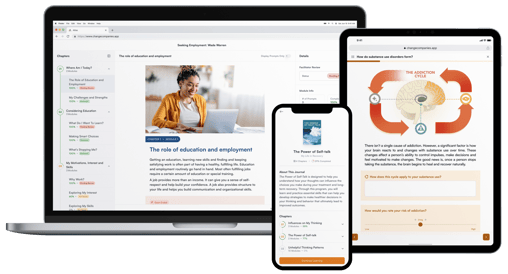
Evidence-based, behavioral health Interactive Journaling® curricula are available digitally on Atlas. Atlas can save staff time while supporting fidelity to evidence-based practices.
Ready to see what Atlas can do for your program? Visit our website to schedule a personalized demo today. Learn more about Atlas →
Provide your information below for a complete overview of Atlas for your setting.