

Adolescence: A critical period for change
The adolescent brain is biologically wired for change. This is due to heightened neuroplasticity, which is the brain's ability to adapt, grow and reorganize itself by forming new connections. This characteristic of adolescence presents a critical opportunity for intervention and prevention efforts aimed at positive change and desistance.
Young people involved in behavioral health programming or the juvenile justice system often face challenges that go far beyond the behavior that eventually brought them there. Justice-involved adolescents experience elevated rates of mental and behavioral health concerns, difficulties with emotional regulation, challenges in relationships, peer pressure and substance use.
These challenges rarely exist in isolation:
-
A young person's ability to manage emotions can affect relationships.
-
Peer relationships can influence decision-making.
-
Substance use can intersect with mental health and coping.
At the same time, adolescence is a critical period of development:
-
Young people’s emotional and reward systems are becoming increasingly active and sophisticated.
-
Simultaneously, the brain systems involved in regulating emotions, controlling impulses, considering consequences, planning and exercising self-control are still developing.
This developmental imbalance can make it more difficult for adolescents to pause, think through a situation and act in healthy, prosocial ways — particularly in emotionally charged or peer-pressure situations. This is why interventions designed with this particular developmental period in mind, that focus on strengthening the skills adolescents are primed to develop can be highly effective.
The age-crime curve
The well-established age-crime curve shows that offending tends to peak during the late teenage years and early adulthood before declining as people mature. Research on desistance suggests that maturation and the social bonds that accompany it can be important drivers of this decline.
But simply getting older does not guarantee that a young person will develop the skills, relationships or support needed to move away from harmful behavior. For adolescents who have experienced gaps in emotional, cognitive or social development, interventions can help provide a foundation for the maturation process. Programs that help strengthen skills linked to maturation, like emotional regulation, relationship building, challenging unhelpful thinking and effective communication can support both healthy development and desistance.
What works?
Evidence supports the use of cognitive behavioral therapy (CBT) and motivational interviewing (MI) with justice-involved youth. Research has found CBT to be a promising approach for addressing behavioral and mental health concerns among juvenile offenders. Motivational interviewing has shown promise, particularly for substance use and engaging young people in treatment.
The National Institute of Justice also highlights the effectiveness of CBT for anger-related problems among children and adolescents. Reviews of CBT interventions found reductions in aggression and anger expression, along with improvements in self-control and problem-solving.
Digital delivery for digital natives
Today’s adolescents and young adults have grown up surrounded by digital technology. One of the most consistent challenges in juvenile justice programming is sustained engagement.
In informal client interviews, interviewers found that the majority of clients using Interactive Journaling® preferred digital journaling over paper-based Journals and in-person groups.
Digital delivery can offer a way to meet young people where they are. Using a format that feels familiar and engaging can create more opportunities for reflection, skill development and active participation. Features such as animation, graphics, video and interactive activities can make learning objectives and concepts more engaging, accessible and memorable.

Re-introducing the Thrive program
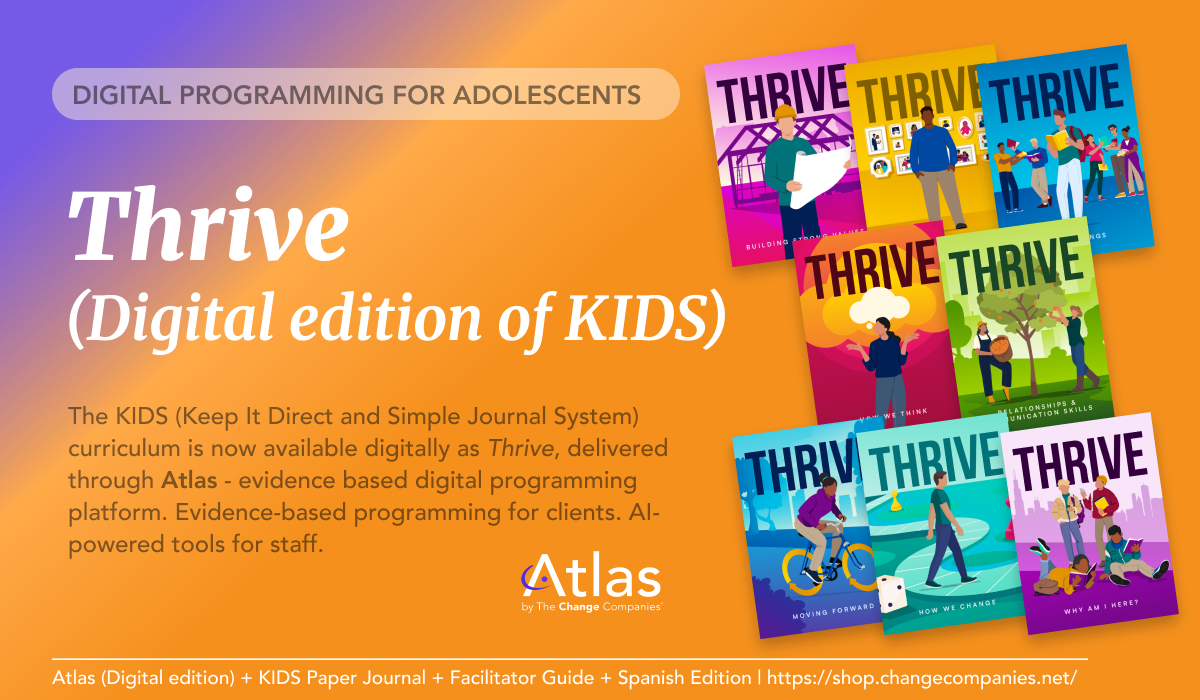
Each of the aforementioned principles informed the major update to our series designed specifically for adolescents and young adults. The Thrive program, (“KIDS” in print), has been rolled out in Atlas after undergoing a serious makeover.
The updated series includes nine interactive journals addressing many of the skills gaps and challenges commonly associated with adolescents in need of behavioral intervention or who are involved in the criminal justice system.
The Journals can be assigned individually, as a complete series or in a custom combination and sequence to meet individual needs.
Thrive series Journals:
Journal 1: Why Am I Here
Journal 2: My Substance Use
Journal 3: My Feelings
Journal 4: My Family
Journal 5: Relationships and Communication
Journal 6: How We Think
Journal 7: How We Change
Journal 8: Building Strong Values
Journal 9: Moving Forward
The series uses cognitive behavioral therapy and motivational interviewing approaches to help participants develop greater self-awareness, examine the connection between their thoughts, feelings, and behaviors and identify meaningful goals for positive change in their lives. Just as important, the language, examples, graphics and prompts were designed specifically for adolescents and young adults.
The update also includes a new video series featuring engaging animations and graphics that bring complex concepts to life.
The new Thrive video library includes animations covering the following:
-
Substance-specific education (alcohol, marijuana, stimulants, opioids, hallucinogens, prescription and over the counter drugs, synthetic drugs and inhalants)
-
Teenage brain development
-
Forming new connections in your brain
To learn more about this series, visit our website to schedule a personalized demo today. See how Atlas works for your agency → Book a quick demo

Evidence-based, behavioral health Interactive Journaling® curricula are available digitally on Atlas. Atlas can save staff time while supporting fidelity to evidence-based practices.
Ready to see what Atlas can do for your program? Visit our website to schedule a personalized demo today. Learn more about Atlas →
Provide your information below for a complete overview of Atlas for your setting.