---
title: "Incentives, innovation and impact: Alameda County’s model for digital behavior change programming with justice-involved youth"
description: See how Digital behavior change programming helped Alameda County Probation turn Atlas into daily practice for justice-involved youth in custody
image: https://blog.changecompanies.net/hubfs/Blog/Banner%20Graphics/appa26%20blog.png
---
[Technical Support](https://support.changecompanies.net/?hsLang=en) [Contact Sales](https://go.changecompanies.net/contact?hsLang=en)
Search changecompanies.net
About Us
[About](https://changecompanies.net/about?hsLang=en) [Leadership](https://changecompanies.net/about?hsLang=en#leadership) [Advisors](https://changecompanies.net/about?hsLang=en#advisors) [Contact Us](https://go.changecompanies.net/contact?hsLang=en) [Careers](https://changecompanies.net/careers?hsLang=en)
[](https://blog.changecompanies.net/)
- Products
Products
[ Atlas: Behavior Change Platform Helps agencies and providers drive measurable behavior change, so fewer people return to custody or use.](https://changecompanies.net/atlas?hsLang=en) [Sessions Plan check-ins and groups, capture notes, and track delivery fidelity, all tied to case and treatment plans.](https://changecompanies.net/atlas-sessions)
[ Paper Journals For 40 years, our printed Interactive Journals have delivered high-quality, durable, full-color curricula — simple to order straight from our store.](https://shop.changecompanies.net/) [ *Interactive Journaling®* Evidence-based expressive writing that blends MI, CBT, and the stages of change to guide lasting change.](https://changecompanies.net/interactive-journaling) [ Clinical Assessments DSM-5 and ASAM Criteria–compatible tools for diagnosis, placement, and service planning, with Evince.](https://shop.changecompanies.net/collections/clinical-assesments)
Training
[ Curriculum Training Train facilitators on the key skills that make *Interactive Journaling®* most effective.](https://changecompanies.net/training?hsLang=en) [ Self-paced Learning The Fidelity Platform: online, self-paced training that upskills facilitators on their schedule.](https://changecompanies.net/fidelity-platform?hsLang=en) [ The ASAM Criteria Open enrollment trainings from Train for Change on ASAM skills, implementation, and CARF certification.](https://changecompanies.net/asam?hsLang=en)
- Solutions
[ Behavioral Health Client-centered resources that boost engagement and scale ASAM-aligned treatment planning.](https://changecompanies.net/behavioral-health) [ Community Corrections Risk-need-responsive tools for probation, parole, diversion, and reentry, without adding staff burden.](https://changecompanies.net/community-corrections) [ Correctional Institutions Evidence-based programming that promotes prosocial change and streamlines reentry.](https://changecompanies.net/prison-jail) [ Juvenile Justice Age-appropriate resources that boost motivation, support case plans, and reduce recidivism.](https://changecompanies.net/solutions-for-juvenile-justice?hsLang=en) [ The ASAM Criteria Learning pathways that help clinicians and agencies implement the ASAM Criteria at every level of care.](https://changecompanies.net/asam?hsLang=en)
- Resources
[Blog](https://blog.changecompanies.net/?hsLang=en) [Case Studies](https://changecompanies.net/case-studies) [Grant Support](https://changecompanies.net/grant-support?hsLang=en) [Webinars](https://changecompanies.net/webinars?hsLang=en) [Resource Center](https://changecompanies.net/resourcecenter) [Motivational Interviewing](https://changecompanies.net/motivational-interviewing?hsLang=en) [Pre/Post-tests](https://changecompanies.net/prepost-tests?hsLang=en) [Tips and Topics](https://changecompanies.net/tipsandtopics?hsLang=en) [Technical Support](https://support.changecompanies.net/?hsLang=en)
- Login
[Atlas](https://changecompanies.app) [Store Account](https://shop.changecompanies.net/account) [eTraining](https://legacy.changecompanies.net/account/login.php) [Fidelity Platform](https://fidelity.changecompanies.net/login)
[Get an Atlas Demo](https://changecompanies.net/atlas/demo?hsLang=en) [Shop Journals](https://shop.changecompanies.net)
[Atlas Demo](https://changecompanies.net/atlas/demo?hsLang=en)
[](https://blog.changecompanies.net/)
Search changecompanies.net
[Get an Atlas Demo](https://changecompanies.net/atlas/demo?hsLang=en) [Shop Journals](https://shop.changecompanies.net)
Open main menu Close main menu
[Case Studies and News](https://blog.changecompanies.net/tag/case-studies-and-news) [Best Practices](https://blog.changecompanies.net/tag/best-practices)
# Incentives, innovation and impact: Alameda County’s model for digital behavior change programming with justice-involved youth

[The Change Companies](https://blog.changecompanies.net/author/the-change-companies)
[Share this blog post on Twitter](https://twitter.com/intent/tweet?text=I+found+this+interesting+blog+post&url=https://blog.changecompanies.net/incentives-innovation-and-impact-how-alameda-county-probation-implemented-atlas-for-justice-involved-youth) [Share this blog post on Facebook](http://www.facebook.com/share.php?u=https://blog.changecompanies.net/incentives-innovation-and-impact-how-alameda-county-probation-implemented-atlas-for-justice-involved-youth) [Share this blog post on LinkedIn](http://www.linkedin.com/shareArticle?mini=true&url=https://blog.changecompanies.net/incentives-innovation-and-impact-how-alameda-county-probation-implemented-atlas-for-justice-involved-youth)
## Summary
Alameda County Probation's implementation of digital behavior change programming through the [Atlas](https://changecompanies.net/atlas) platform shows that youth engagement with [*Interactive Journaling®*](https://changecompanies.net/interactive-journaling) rises sharply once staff ownership, phased rollout, and leadership reinforcement are built into daily facility routine.
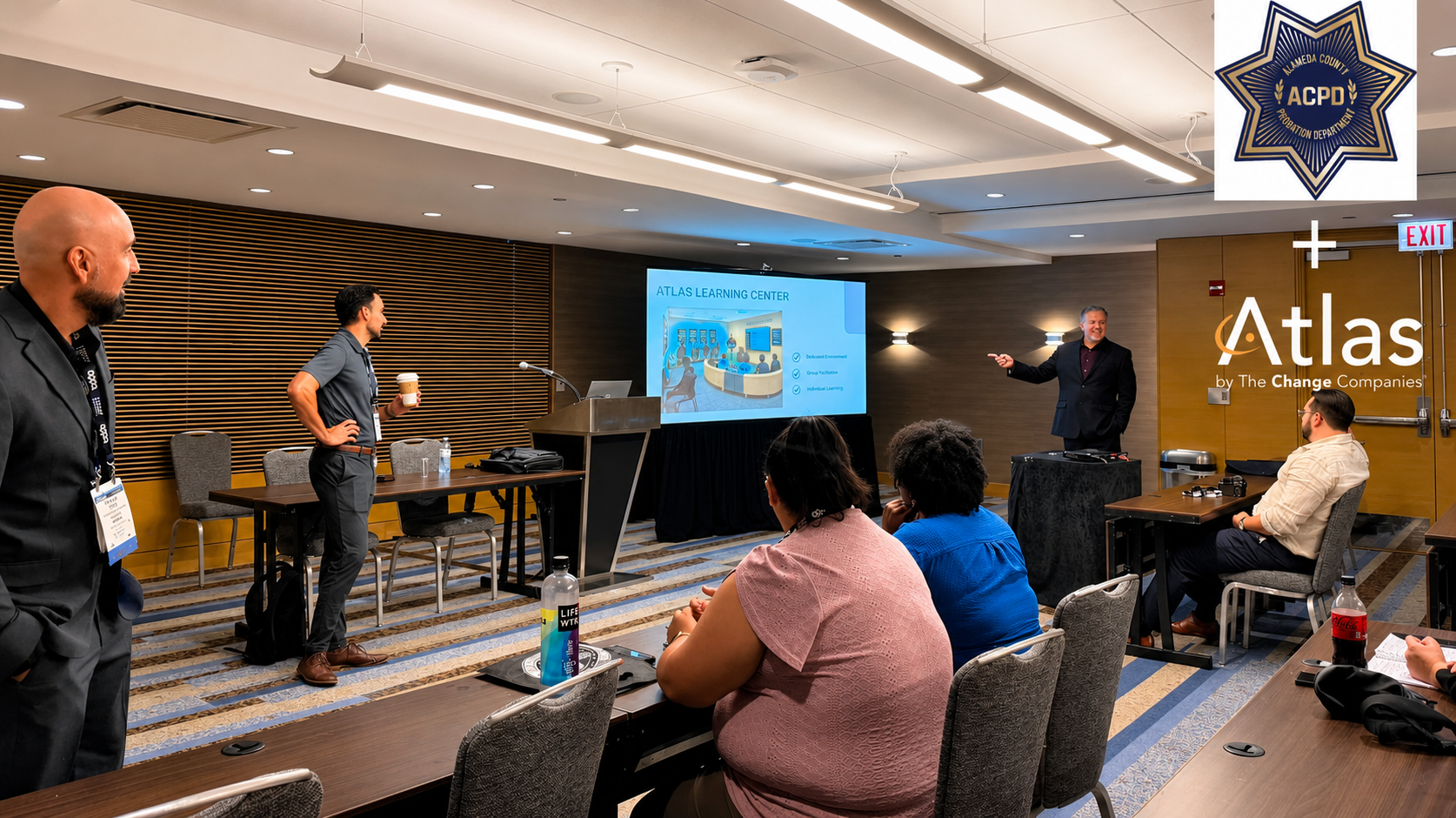
The Change Companies recently joined the [Alameda County Probation Department](https://probation.acgov.org/index.page) at the American Probation and Parole Association (APPA) 2026 Summer Training Institute to share an inside look at the county’s implementation of [Atlas](https://changecompanies.net/atlas) for youth in its juvenile facilities.
The session, “Incentives, Innovation, and Impact: A New Model for Digital Behavior Change Programming with Justice-Involved Youth,” was presented by Richard Valle, Assistant Superintendent with Alameda County Probation; Albert Bañuelos, Deputy Director with Alameda County Probation; and Kyle Athans, Vice President of Sales with The Change Companies.
Alameda County Probation currently serves approximately 52 youth in custody, in addition to more than 400 youth under field supervision. The presentation explored what the county is doing with digital cognitive behavioral interventions (CBI) and, importantly, how they turned a promising idea into part of everyday facility practice.
As the presenters acknowledged, justice agencies rarely suffer from a shortage of good ideas. The challenge is creating the staff ownership, structure and consistency necessary for those ideas to survive implementation.
### Making behavior change programming more accessible
Alameda County began with a simple premise: CBI is only valuable when youth can actually engage with it consistently.
Youth in the facility already had access to tablets. [Atlas](https://changecompanies.net/atlas) created an opportunity to use those devices as another pathway to structured behavior change programming, giving youth access to [*Interactive Journaling*®](https://changecompanies.net/interactive-journaling) content focused on reflection, accountability and skill development.
The goal wasn't to simply put more content on a tablet. Alameda wanted to bring CBI into the daily rhythm of the facility, expand access beyond scheduled groups and connect programming to individual case plans and behavior change goals. At the same time, staff could gain greater visibility into participation, progress and completion.
The county also approached dosage intentionally. Rather than assuming that more programming is always better, its model matches intervention intensity to risk and need, with target ranges of 100–149 hours for lower-risk youth, 150–200 hours for moderate-risk youth and 200–249 hours for higher-risk youth.
### From a good idea to daily practice
A major focus of the APPA session was implementation.
Instead of treating implementation as a one-time launch, Alameda County developed a phased process that included:
- communicating the purpose of Atlas
- defining staff responsibilities
- training and preparation
- launching with selected units,
- monitoring progress
- using early data to continually refine the model
One lesson stood out: successful implementation can't depend on two or three highly motivated staff members.
The county worked to engage roughly 50 staff members in the implementation, with a smaller group emerging as program leaders. Roles were deliberately clarified across deputy probation officers, juvenile institutional officers, supervisors, clinicians and administrators.
Training included both in-person and virtual support, and implementation was phased rather than facility-wide from day one. That phased approach gave staff an opportunity to identify problems, adapt and build confidence before scaling.
It also demonstrated why leadership continuity matters. When a management transition occurred during implementation, participation dropped. Rather than treating the decline as evidence that the intervention wasn't working, the team used its monthly data to identify the implementation issue and rebuild momentum.
A key takeaway is that simply adding a program to the tablet doesn’t ensure implementation. Rather, the program has to become part of the facility's structure.
As the presentation summarized, staff need clear ownership of Journal assignments, participation, progress and flags; leadership must reinforce the work as a priority; and expectations, incentives and follow-up need to become part of the facility routine.
### Designing incentives that matter to youth
Alameda County also experimented with incentives to encourage initial engagement and reinforce consistency.
Youth can earn $50 gift cards for completing assigned Journals, with rewards selected around practical needs they may encounter after release — including groceries, diapers or formula. Rather than receiving the gift cards immediately, youth collect certificates recognizing their progress and redeem the incentives upon release.
The incentive system produced an unexpected lesson early on.
One motivated young person discovered that the original rules didn't clearly distinguish between assigned and self-selected Journals. He independently completed 20 elective Journals and made a case that he had earned $1,000.
The county revised its guidance.
It's a lighthearted example, but it illustrates a larger point about implementation: young people will quickly show you where your program design needs refinement.
The county now clearly communicates that incentives apply to assigned Journals, with staff verifying completion. Smaller milestones are reinforced through stickers, certificates and recognition as well. The objective is to help youth experience Atlas as part of a personal growth plan rather than simply another required activity.
Just as important is following through. Presenters emphasized that when an incentive is promised, it needs to be delivered. A broken promise doesn't just undermine a program — it can undermine the credibility of the frontline staff member who made that promise to a young person.
### Early signs of engagement
Alameda County began implementing Atlas in early 2026 and has used monthly Atlas Impact Reports to monitor dosage, completed Journals and participation.
The implementation experienced some early fluctuations, including a decline during the management transition. By July, however, youth had completed 416 hours of programming and 89 Journals in a single month, a significant increase from 136 dosage hours and 18 completed Journals in June.
The numbers are useful, but Alameda County has been careful not to confuse participation with outcomes. As emphasized during the presentation, participation should be tracked as a pathway to skill practice, while early implementation data should inform continuous quality improvement before longer-term outcome conclusions are drawn.
Early reflections from youth provide another window into the experience.
“I've become more composed and less impulsive.”
Another young person described “talking to my family about good things and my future,” while another highlighted the use of “deep breathing techniques.”
These responses reflect the kinds of skills the program is intended to encourage: future thinking, positive self-talk, emotional expression, grounding and self-reflection.
[](https://blog.changecompanies.net/hs/cta/wi/redirect?encryptedPayload=AVxigLL21kT553zs9WLDbc%2BVJ3CfdYStUmCflIktTPPKYhd1yDcuTYCCdFLR9v%2BjyeHOQBwoVkE9NoauVfsb22H1Vv45nrZUEEtpdiuoooSGL1IUTkatvTexGNV4watXcjkC4Kv0FremO6OIjAQyZQ5QfU2w7QAiMVs9ddh94ncrwtdBZZ6%2BOUzvSQBrWp4fsu1WjS3ZFLuwrT9c8VV1qeY%3D&webInteractiveContentId=210836473477&portalId=20881724)
### Connecting Journal work to the people supporting youth
One of the more unexpected developments has been how Atlas information is beginning to travel beyond the facility.
[Atlas](https://changecompanies.net/atlas) includes a flagging system that helps staff identify responses that may require additional attention. Lower-level concerns can be reviewed by supervisory staff, while urgent concerns — including potential self-harm — can be escalated to mental health clinicians in real time.
The county has also begun incorporating Atlas-generated information into youth progress reports submitted to the court.
Rather than simply reporting whether a young person completed an assignment, these reports can describe the areas youth are working on and signs of growth. Examples shared during the presentation highlighted reflection on family dynamics, decision-making, difficult feelings, reentry planning and future goals.
Judicial interest has followed. According to presenters, judges have begun asking about greater access to Atlas information, and one judge suggested incorporating Journal completion into decisions around court continuances.
That interest creates both opportunity and important policy questions for Alameda County as it determines how progress information should appropriately be shared and used.
The implementation is also attracting attention from the county's field services staff. Deputy probation officers working outside the facility are now requesting Atlas training after seeing how the platform is being used inside.
### Where Alameda County goes next
Alameda County's longer-term vision extends beyond the current facility implementation.
One possibility is a dedicated Atlas Learning Center: a comfortable space with individual workstations for self-directed Journaling alongside space and technology for facilitated exercises. The concept would create an environment specifically designed for both individual reflection and group learning.
The county is also exploring what continuity could look like after release. Because Atlas can be accessed digitally, youth could potentially continue assigned programming on personal devices as they transition to field supervision or aftercare, allowing probation staff to maintain visibility into progress.
This may be particularly important for youth served under California's SB 823 realignment, some of whom may remain in county custody for two years or longer. Longer stays create an opportunity to reach higher levels of evidence-informed CBI dosage while also giving the county a population with whom it can begin examining longer-term behavioral and recidivism outcomes.
### The bigger implementation lesson
Perhaps the most transferable lesson from Alameda County's experience has little to do with technology.
Digital access can remove barriers. Incentives can encourage engagement. Data can make participation visible. But none of those elements replaces the work of implementation.
Programs gain traction when staff understand why the work matters, know exactly what role they play, receive the preparation and support they need, and see leadership consistently reinforce the program as part of everyday practice.
For Alameda County, [Atlas](https://changecompanies.net/atlas) is increasingly becoming more than content available on a tablet. It's becoming part of a broader system connecting structured skill practice, staff support, incentives, progress monitoring and eventually the transition back into the community.
And that may be the most important lesson for other juvenile justice agencies considering digital programming: technology can create access, but thoughtful implementation is what turns access into an opportunity for change.
See how[Atlas](https://changecompanies.net/atlas) works for your agency → [Book a quick demo](https://changecompanies.net/atlas/demo)
---
[](https://changecompanies.net/atlas)
Evidence-based, behavioral health[Interactive Journaling®](https://changecompanies.net/interactive-journaling) curricula are available digitally on [Atlas](https://changecompanies.net/atlas). Atlas can save staff time while supporting fidelity to evidence-based practices.
Ready to see what Atlas can do for your program? Visit our website to schedule a personalized demo today. [Learn more about Atlas →](https://changecompanies.net/atlas/demo)
Provide your information below for a complete overview of [Atlas](https://changecompanies.net/atlas) for your setting.

#### The Change Companies
For over 30 years, The Change Companies has delivered cutting-edge behavior change tools to over 26 million individuals in addiction treatment and justice services. We combine the latest change research with end-user feedback to continually improve the design and delivery of innovative solutions, such as our evidence-based practice of Interactive Journaling®, our programming platform, Atlas, and our live and on-demand skills-based training programs.
[](https://changecompanies.net/)
Developing evidence-based solutions that help people make positive life changes.
##### Products
[Interactive Journaling®](https://changecompanies.net/interactive-journaling) [Atlas: Programming Platform](https://changecompanies.net/atlas?hsLang=en) [Clinical Assessments](https://shop.changecompanies.net/collections/clinical-assesments)
##### Solutions
[Behavioral Health](https://changecompanies.net/behavioral-health) [Community Corrections](https://changecompanies.net/community-corrections) [Correctional Institutions](https://changecompanies.net/prison-jail) [Opioid Abatement](https://changecompanies.net/opioid-abatement?hsLang=en) [Juvenile Justice](https://changecompanies.net/solutions-for-juvenile-justice?hsLang=en)
##### Login
[Atlas](https://changecompanies.app) [Store Account](https://shop.changecompanies.net/account) [eTraining](https://legacy.changecompanies.net/account/login.php) [Fidelity Platform](https://fidelity.changecompanies.net/login)
##### Support
[Submit a Ticket](https://go.changecompanies.net/bug-issue) [Technical Support](https://support.changecompanies.net/)
##### Resources
[Blog](https://blog.changecompanies.net/?hsLang=en) [Case Studies](https://changecompanies.net/case-studies) [Grant Support](https://changecompanies.net/grant-support?hsLang=en) [Webinars](https://changecompanies.net/webinars?hsLang=en) [Resource Center](https://changecompanies.net/resourcecenter) [Tips and Topics](https://changecompanies.net/tipsandtopics?hsLang=en)
##### Training
[Curriculum Training](https://changecompanies.net/training?hsLang=en) [Self-paced Learning](https://changecompanies.net/fidelity-platform?hsLang=en) [The ASAM Criteria](https://changecompanies.net/asam?hsLang=en)
##### Subscribe
Stay updated with our latest news and product releases.
[Subscribe to Updates](https://share.hsforms.com/1u_jrRk3sTyWSKk-Yalo2zQcfkfw)
##### Ready to learn more?
See how Atlas delivers behavior change for clients and AI-powered resources for staff.
[Book an Atlas Demo →](https://changecompanies.net/atlas/demo)
© 2026 The Change Companies. All rights reserved.
[Privacy Policy](https://changecompanies.net/privacy-policy) [Terms of Use](https://changecompanies.net/terms-of-use) [(888) 889-8866](tel:18888898866)
```json
{
"@context" : "https://schema.org",
"@type" : "BlogPosting",
"author" : {
"@type" : "Person",
"name" : "The Change Companies",
"url" : "https://blog.changecompanies.net/author/the-change-companies"
},
"dateModified" : "2026-08-31T20:15:42.311Z",
"datePublished" : "2026-08-27T19:14:47.000Z",
"headline" : "Incentives, innovation and impact: Alameda County’s model for digital behavior change programming with justice-involved youth",
"image" : [ "https://blog.changecompanies.net/hubfs/Blog/Banner%20Graphics/appa26%20blog.png" ],
"mainEntityOfPage" : {
"@id" : "https://blog.changecompanies.net/incentives-innovation-and-impact-how-alameda-county-probation-implemented-atlas-for-justice-involved-youth",
"@type" : "WebPage"
},
"publisher" : {
"@type" : "Organization",
"logo" : {
"@type" : "ImageObject",
"url" : "https://blog.changecompanies.net/hubfs/TCClogo_website.png"
},
"name" : "The Change Companies"
}
}
```
```json
{
"@context" : "https://schema.org",
"@type" : "VideoObject",
"caption" : {
"@type" : "MediaObject",
"contentUrl" : "https://blog.changecompanies.net/media-transcripts/220487916852/en.vtt",
"inLanguage" : "en",
"name" : "en Captions"
},
"contentUrl" : "https://20881724.fs1.hubspotusercontent-na1.net/hubfs/20881724/video_assets/220487916852/inherited/web_optimized.mp4",
"dateModified" : "2026-09-01T20:18:08.679Z",
"duration" : "PT2M56.76S",
"height" : 2160,
"name" : "Atlas Video",
"thumbnailUrl" : "https://changecompanies.net/hubfs/Videos/Atlas%20updates/Alameda%20County%20Probation%20Atlas%20Video.mp4/medium.jpg",
"uploadDate" : "2026-08-27T17:25:09.579Z",
"width" : 3840
}
```