


At the start of each Interactive Journal is an introduction that sounds something like this: “Interactive Journaling® is a tool for you. Don’t worry about your spelling, grammar or neatness. The openness and honesty of your reflections is what matters most.”
That promise is true. But what happens when a participant struggles to express themselves in writing at all?
Maybe they have trouble understanding the prompt or topic at hand. Maybe English is their second language. Maybe a brain injury, a learning disability or the early weeks of recovery make it hard to focus or remember what they just read.
When writing is a challenge for participants, it can look like a lack of motivation or dedication. In fact, it may be an issue of program format not fully meeting participants’ needs.
Who may struggle to put their thoughts into writing
The number of participants who find writing hard may be larger than it looks. These groups often overlap, and many of their needs go unreported or overlooked.
-
Limited literacy. A national study found 29% of incarcerated adults have low literacy skills. For U.S. adults overall, the rate is 19%.
-
Traumatic brain injury (TBI). Research cited by the CDC suggests close to half (46%) of people in prisons and jails have a history of TBI.
-
Cognitive and learning disabilities. SAMHSA estimates that coexisting disabilities may affect up to 40% of clients in substance use treatment.
-
Early recovery. Substance use can affect attention, working memory and planning. Many of these skills improve with time, so what’s hard early on may get easier.
-
English learners. Difficulty reading and writing in English is not the same as difficulty understanding or reflecting.
-
Sensory and physical disabilities. Low vision, fine motor impairments and other challenges common among older adults and people in recovery can make reading and writing harder.
Health literacy experts recommend a universal precautions approach: assume anyone may have trouble understanding, and make materials clear for everyone.
Writing has been at the heart of Interactive Journaling® for more than 35 years, and the research behind expressive writing is solid. Still, that kind of writing can be hard to reach for someone who struggles with literacy, language or memory.
What facilitators and staff can do
Here are strategies that help across literacy, language and cognitive needs.
-
Shrink the task. Try one page or one question at a time. Shorter sessions and planned breaks help with the fatigue and focus limits that often come with TBI, early recovery and other challenges.
-
Read content aloud. When possible, facilitators may use session time to read or summarize content out loud.
-
Invite "teach-back." Participants might summarize or "teach-back" what they heard by explaining concepts in their own words.
-
Let speaking count. Speaking can be as helpful as writing. A participant can talk through a response with a staff member or peer, or record their thoughts.
-
Offer alternatives to written responses. In addition to speaking, participants may be able to effectively express themselves through drawing or another creative medium.
-
Support language, not just literacy. Offer materials in a participant’s primary language when you can. All digital and many printed Interactive Journals are available in Spanish.
-
Screen privately and plan ahead. Look for literacy and cognitive needs at intake, not in front of a group. Then build what you learn into the case plan. SAMHSA notes that many accommodations are simple and low-cost, but they do take planning.
-
Measure engagement, not word count. Look at the depth of a reflection, not its length. A few honest words can say a lot.
-
Build on what’s written. Use even a short written response as a jumping-off point for one-on-one or group discussion.
-
Normalize alternatives for the whole room. To prevent stigma, make accommodations standard options for everyone. Invite the entire group to use bullet points, draw their answers or discuss prompts with a partner instead of writing in complete sentences.
How digital delivery can help
Digital tools can help alleviate literacy, language and cognitive barriers. In Atlas, our digital Interactive Journaling® platform:
-
Audio features read Journaling content aloud in English and Spanish for participants with limited literacy or vision.
-
Browser translation tools, like the one built into Chrome, can translate on-screen text into many other languages.
-
Self-paced work lets participants pause, replay and come back when they’re ready.
-
Illustrations, animations and a multimedia library of videos, podcasts and skills support different learning styles and aid comprehension. Videos in Atlas include Spanish captions.
-
Real-time summaries and flagged responses help staff spot who is stalling, so they can check in early.
Privacy matters, too. In one evaluation, participants said digital journaling gave them more privacy, which led to more honest reflection. For someone who feels self-conscious about spelling or handwriting, that can make it easier to open up.

Digital isn’t the whole answer
Digital tools cannot replace the work of a skilled facilitator. Some participants will need more hands-on support than self-paced content can give. Tech literacy can also be a barrier. Using a tablet or app may seem simple today, but it can be new for people who have been incarcerated for long periods, older adults and some people with disabilities. Digital work will always be most effective when it’s paired with regular staff check-ins.
Finding the right way to connect
The goal of Interactive Journaling® isn’t polished writing. It’s honest reflection, in whatever form works for the person doing it.
When you adjust the format, more participants get a real chance to do that work. A recorder, a shorter session, a page in their first language or a Journal that reads itself aloud in English or Spanish can each open the door.
If your team is looking for ways to reach participants who struggle with reading, writing or focus, we’d welcome the conversation. See how Atlas could work in your setting, explore Curriculum Training or give us a call to build these skills across your organization.
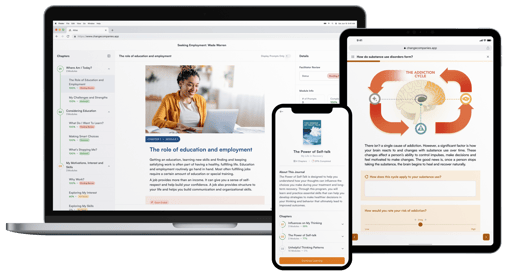
Evidence-based, behavioral health Interactive Journaling® curricula are available digitally on Atlas. Atlas can save staff time while supporting fidelity to evidence-based practices.
Ready to see what Atlas can do for your program? Visit our website to schedule a personalized demo today. Learn more about Atlas →
Provide your information below for a complete overview of Atlas for your setting.