

As community corrections professionals know, successful reentry is a multifaceted process that requires a holistic approach. Reentry after incarceration requires a person to navigate changing relationships, manage difficult emotions, establish financial stability and develop the skills and support systems that can help them move forward. Providing opportunities before release to prepare for these challenges is an important part of supporting successful reintegration and reducing recidivism.
The Transition Skills Journal is designed to support programming for individuals returning to the community. Through guided reflection, practical exercises and evidence-based strategies, participants can explore their expectations for reentry, identify potential challenges and develop skills to help them navigate their next steps with greater confidence and purpose.
Research discussed by the NIJ and the National Academies of Sciences, Engineering, and Medicine emphasizes the importance of hope, personal agency and overall well-being in the reentry process. A broader understanding of success considers not only whether someone returns to the justice system, but also how they are doing and what support they need to thrive.
Important indicators of progress can include:
-
Personal well-being
-
Healthy relationships
-
Stability and independence
-
Community connection
Introducing the updated Transition Skills Journal

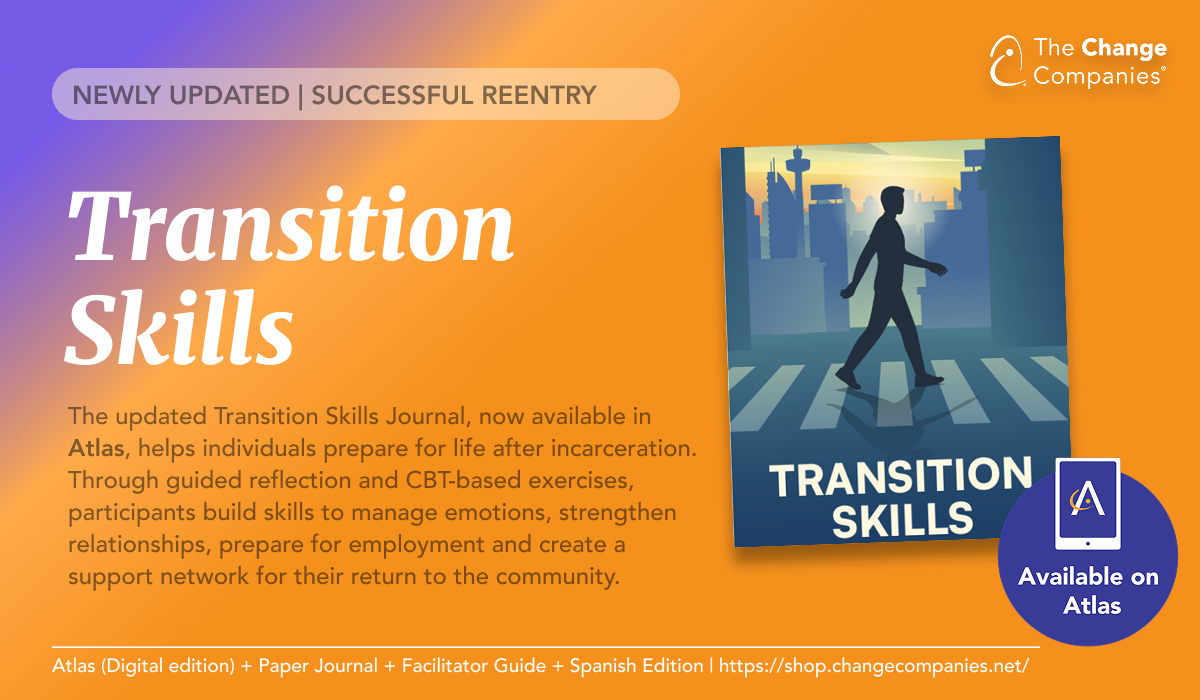
The Change Companies is excited to share that Transition Skills has undergone a major update and is now available on Atlas in an engaging, interactive and beautifully designed digital Journal. The original print Journal was created in partnership with the Federal Bureau of Prisons as a nine-week program to support successful transition.
The updated curriculum features more CBT-based content, expanded sections focused on practical skills and checkpoints in transition and updated best-practice language and illustrations.
Inside the Journal, participants will explore nine key learning areas:
-
Manage expectations: Prepare mentally for returning to the community, recognize how circumstances may have changed, and approach the transition with an open mind.
-
Harness the power of self-talk: Apply cognitive behavioral therapy (CBT) principles to recognize thought patterns and develop more helpful ways of thinking.
-
Manage difficult feelings: Recognize, understand and respond constructively to challenging emotions using several strategies introduced in this chapter.
-
Build and manage healthy relationships: Consider the characteristics and benefits of healthy relationships and identify people they would like to reconnect or strengthen their relationship with.
-
Manage their time: Balance responsibilities, create structure and make constructive choices during unstructured time.
-
Handle social influences: Recognize how others can influence decisions and practice strategies for responding to social pressure.
-
Navigate transition checkpoints: Identify essential practical tasks, including obtaining identification, applying for benefits, establishing healthcare, opening a bank account and more.
-
Prepare for employment: Explore employment opportunities, personal interests and the benefits of meaningful work.
-
Build a safety net: Identify supportive family members, peers, mentors and professionals who can provide guidance throughout the transition.
The updated digital experience also includes chapter progress summaries, allowing participants to review their learning, reflect on their progress and identify areas where they may need additional support.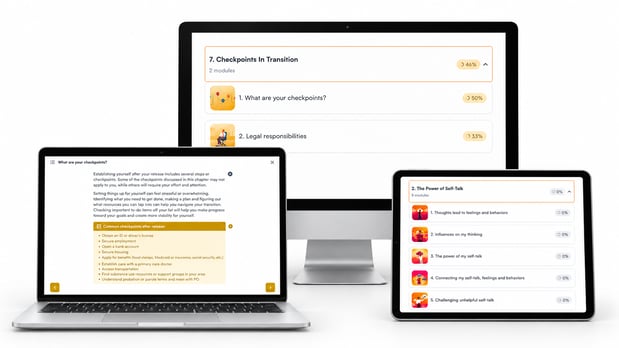

Connecting research and practice: Applying what we know about reentry
The National Institute of Justice (NIJ), in its article Five Things About Reentry, highlights important research findings that can inform effective reentry programming. These include:
- Cognitive behavioral therapy (CBT) interventions, which “benefit all facets of reentry”
- Tailored to meet individual needs
- Comprehensive support that considers mental and physical health, financial stability, relational needs and a sense of efficacy and hope
All of The Change Companies’ curricula are CBT-based, meaning participants work on core cognitive behavioral skills every time they open a Journal. These skills help individuals recognize the connections between thoughts, feelings and behaviors and develop more constructive ways to respond to challenges.
Individualization is central to Interactive Journaling®, which asks participants to reflect on their own experiences, identify their individual needs and consider how new strategies apply to their lives. Rather than simply absorbing information, they actively engage with the material and connect it to their own circumstances. Atlas further supports individualized programming by allowing facilitators to assign Journals from the curriculum library based on participants’ risk and needs assessments.
In Transition Skills, participants have the opportunity to gain practical knowledge and skills and begin planning for a wide range of new challenges and responsibilities. The updated Journal reflects a holistic approach to reentry; one that touches on behavioral skills, personal well-being, relational capacity and practical stability
See Transition Skills in action. Request an Atlas demo → Book a quick Atlas demo.
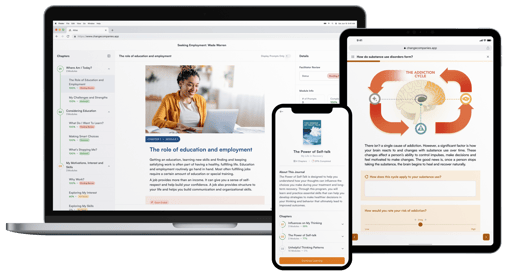
Evidence-based, behavioral health Interactive Journaling® curricula are available digitally on Atlas. Atlas can save staff time while supporting fidelity to evidence-based practices.
Ready to see what Atlas can do for your program? Visit our website to schedule a personalized demo today. Learn more about Atlas →
Provide your information below for a complete overview of Atlas for your setting.