

Successful reentry takes more than a job and a place to live. People coming home also need motivation, healthy ways to handle hard feelings and confidence that they can build a different life. The question becomes: how can programs and organizations support those needs with limited staff time?
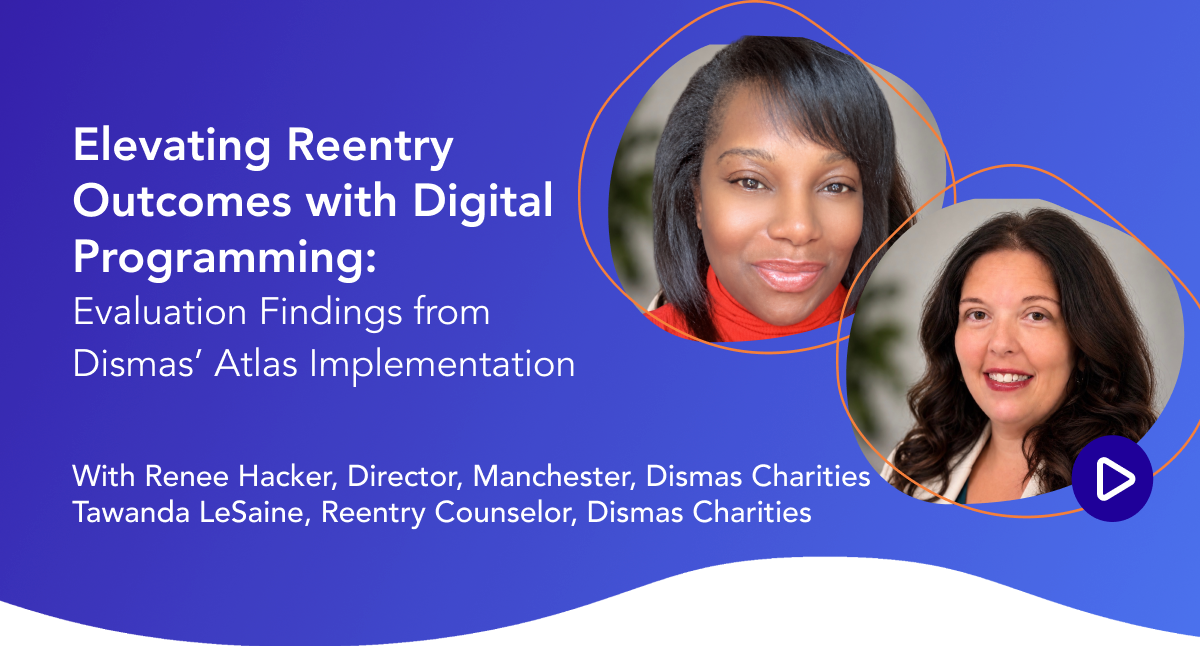
In our recent webinar, Elevating Reentry Outcomes with Digital Programming, Valerie Bagley, Chief Program Officer at The Change Companies, shared findings from an evaluation of Atlas at two Dismas Charities reentry sites. She was joined by Director Renee Hacker and Reentry Counselor Tawanda LeSaine of Dismas Charities, who shared what implementation looks like day to day.
Here are the key takeaways.
The foundation: Interactive Journaling®
Interactive Journaling® has been used for nearly 40 years across corrections, behavioral health and substance use treatment. It blends motivational interviewing, cognitive behavioral approaches and the stages of change. Journals use brief blocks of text, core graphics and reflective questions so they are easy to read and engage with.
Research in community settings is promising. Graduates of one North Carolina court diversion program saw a 32% drop in recidivism. Participants in a New York City mentoring program had a 69% lower felony reconviction rate at 12 months than their peers. And in New York opioid courts, people using Interactive Journaling® were more likely to graduate from treatment.
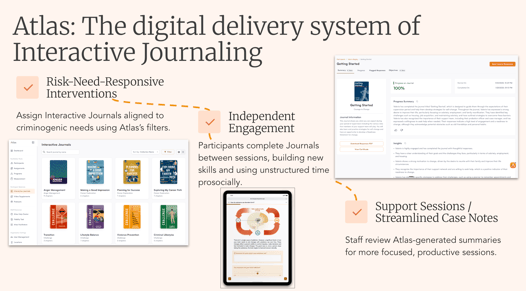
Atlas delivers these Journals digitally. Staff assign Journals based on risk-need assessments, clients work through them between sessions, and staff review summaries to guide focused conversations. Journals are also supported by evidence-based videos, podcasts, guided practices and other content unique to this digital format.
How Oregon Recovery got more individuals access to and engaged in programming →
What an independent evaluation found
The evaluation included a rural site (Manchester, Kentucky) and an urban site (Atlanta, Georgia). Staff and clients completed surveys and 60-minute interviews.
The strongest results came in two areas at the heart of behavior change:
-
Motivation: 90% of clients and 100% of staff said Atlas helped increase motivation to make positive changes.
-
Confidence: 90% of clients and staff said Atlas helped build confidence in the ability to make life changes. As one Atlanta client put it, "It helped me start to realize that I'm not a number."
Clients also reported benefits in reentry preparation, managing relationships, handling anger and overall quality of life. Some of the most moving stories were about parenting. "I never had patience before, but I have so much patience with [my son] now," one client shared. "That came from actually sitting down and thinking through the journaling."
Journals open the door to harder conversations
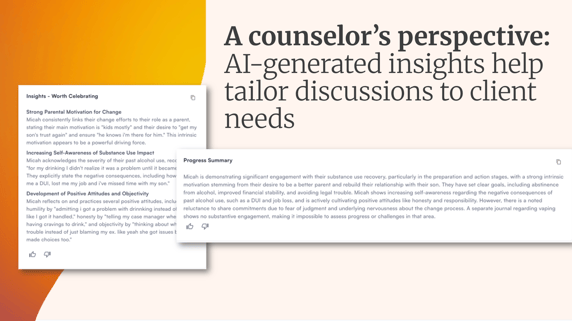
Many clients hold back in face-to-face meetings. Tawanda described a client who kept saying his mental health was "good." Once she assigned him a mental health Journal, he wrote about tension with his sister and daughter. That gave her a natural way to start the conversation: "I saw that you put this in your Journal. Do you want to talk about it?"
She also relies on the suggested questions in Atlas summaries, which often lead to new topics for discussion, such as family support. Renee added that flags help staff spot concerns early. When one resident filled his Journal with "I don't care," Renee told him she thought he cared more than he let on and asked him to try again. He did.
Frame it as a tool, not a task
Both Renee and Tawanda admitted that Atlas felt like "just another task" at first. Renee said leaders need to connect new tools to the mission: helping clients reach their goals. When staff see a tool as helpful, clients will too. One of her once-hesitant counselors now says that when she can't think of a resource for a client, she goes to Atlas.
Tawanda also uses Atlas Sessions to record and transcribe meetings, so she can listen to her client instead of focusing on typing. The fidelity report helps her notice when her wording may sound judgmental.

Meeting clients where they are
Many residents don't have a computer. In Manchester, they use tablets, smartphones and QR codes to access Atlas. For clients with internet restrictions, staff work with probation officers, use locked-down tablets or complete Journals together in session. Printed Journals are still available, too.
Renee also shared some practical wins:
-
Privacy: Residents like that a digital Journal isn't left lying around for others to read.
-
Accessibility: Podcasts help older residents and those who struggle with reading. One resident used Atlas to work toward his goal of improving his English.
-
Real-world recognition: Completion certificates helped one mother meet a parenting class requirement to restart visits with her children, at no cost to her. Local courts have also recognized Atlas work toward substance use treatment hours.
Listening to feedback
Valerie closed by sharing how The Change Companies responded to critical feedback from the evaluation:
-
Yellow flags were viewed as overly sensitive and adding administrative burden. Yellow flags (signs of disengagement) are now less sensitive, cutting the extra work for facilitators. The dashboard also now shows participants with flags, as opposed to total flags, and a bulk review feature for yellow flags has been added.
-
A need for evidence-based sex offense treatment was shared by staff, and as a result the Preparing to Change curriculum for sex offense treatment was added to Atlas.
-
Both staff and clients requested more gender-responsive content, and The Change Companies responded by adding a video collection of women's lived experience, with plans to build the Atlas edition of the WRNA Collection in 2027.
Bringing these lessons to your program
What outcomes matter most to your agency? Attendees named employment, housing, substance use, mental health and family reunification. These needs are connected, and progress in one area often supports another.
Looking for ways to build motivation and spark deeper conversations with the people you serve? Explore Atlas or request a demo. You can also find upcoming sessions on our webinars page.
About our guests

Tawanda LeSaine is a Reentry Counselor at Dismas Charities in Atlanta, Georgia. She has more than seven years of experience supporting justice-involved people through reentry planning, counseling and case management.
Renee Hacker, LPCC, is the Director of Dismas Charities in Manchester, Kentucky. She has over nine years of leadership experience and eight years of experience in substance use and mental health counseling.
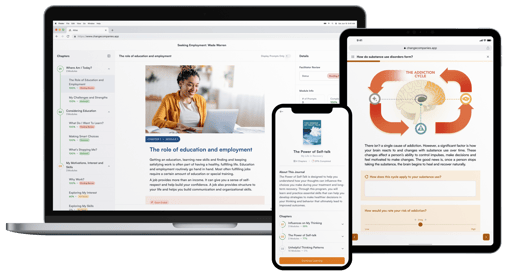
Evidence-based, behavioral health Interactive Journaling® curricula are available digitally on Atlas. Atlas can save staff time while supporting fidelity to evidence-based practices.
Ready to see what Atlas can do for your program? Visit our website to schedule a personalized demo today. Learn more about Atlas →
Provide your information below for a complete overview of Atlas for your setting.