---
title: Why gender-responsive care matters in addiction treatment
description: Learn why gender-responsive care matters in addiction treatment, and how the newly updated Women in Recovery Journal offers a trauma-sensitive solution.
image: https://blog.changecompanies.net/hubfs/Blog/Banner%20Graphics/Women%20in%20recovery%20(6).png
---
[Technical Support](https://support.changecompanies.net/?hsLang=en) [Contact Sales](https://go.changecompanies.net/contact?hsLang=en)
Search changecompanies.net
About Us
[About](https://changecompanies.net/about?hsLang=en) [Leadership](https://changecompanies.net/about?hsLang=en#leadership) [Advisors](https://changecompanies.net/about?hsLang=en#advisors) [Contact Us](https://go.changecompanies.net/contact?hsLang=en) [Careers](https://changecompanies.net/careers?hsLang=en)
[](https://blog.changecompanies.net/)
- Products
Products
[ Atlas: Behavior Change Platform Helps agencies and providers drive measurable behavior change, so fewer people return to custody or use.](https://changecompanies.net/atlas?hsLang=en) [Sessions Plan check-ins and groups, capture notes, and track delivery fidelity, all tied to case and treatment plans.](https://changecompanies.net/atlas-sessions)
[ *Interactive Journaling®* Evidence-based expressive writing that blends MI, CBT, and the stages of change to guide lasting change.](https://changecompanies.net/interactive-journaling) [ Clinical Assessments DSM-5 and ASAM Criteria–compatible tools for diagnosis, placement, and service planning, with Evince.](https://shop.changecompanies.net/collections/clinical-assesments)
Training
[ Curriculum Training Train facilitators on the key skills that make *Interactive Journaling®* most effective.](https://changecompanies.net/training?hsLang=en) [ Self-paced Learning The Fidelity Platform: online, self-paced training that upskills facilitators on their schedule.](https://changecompanies.net/fidelity-platform?hsLang=en) [ The ASAM Criteria Open enrollment trainings from Train for Change on ASAM skills, implementation, and CARF certification.](https://changecompanies.net/asam?hsLang=en)
- Solutions
[ Behavioral Health Client-centered resources that boost engagement and scale ASAM-aligned treatment planning.](https://changecompanies.net/behavioral-health) [ Community Corrections Risk-need-responsive tools for probation, parole, diversion, and reentry, without adding staff burden.](https://changecompanies.net/community-corrections) [ Correctional Institutions Evidence-based programming that promotes prosocial change and streamlines reentry.](https://changecompanies.net/prison-jail) [ Juvenile Justice Age-appropriate resources that boost motivation, support case plans, and reduce recidivism.](https://changecompanies.net/solutions-for-juvenile-justice?hsLang=en) [ The ASAM Criteria Learning pathways that help clinicians and agencies implement the ASAM Criteria at every level of care.](https://changecompanies.net/asam?hsLang=en)
- Resources
[Blog](https://blog.changecompanies.net/?hsLang=en) [Case Studies](https://changecompanies.net/case-studies) [Grant Support](https://changecompanies.net/grant-support?hsLang=en) [Webinars](https://changecompanies.net/webinars?hsLang=en) [Resource Center](https://changecompanies.net/resourcecenter) [Motivational Interviewing](https://changecompanies.net/motivational-interviewing?hsLang=en) [Pre/Post-tests](https://changecompanies.net/prepost-tests?hsLang=en) [Tips and Topics](https://changecompanies.net/tipsandtopics?hsLang=en) [Technical Support](https://support.changecompanies.net/?hsLang=en)
- Login
[Atlas](https://changecompanies.app) [Store Account](https://shop.changecompanies.net/account) [eTraining](https://legacy.changecompanies.net/account/login.php) [Fidelity Platform](https://fidelity.changecompanies.net/login)
[Get an Atlas Demo](https://changecompanies.net/atlas/demo?hsLang=en) [Shop Journals](https://shop.changecompanies.net)
[Atlas Demo](https://changecompanies.net/atlas/demo?hsLang=en)
[](https://blog.changecompanies.net/)
Search changecompanies.net
[Get an Atlas Demo](https://changecompanies.net/atlas/demo?hsLang=en) [Shop Journals](https://shop.changecompanies.net)
Open main menu Close main menu
[Best Practices](https://blog.changecompanies.net/tag/best-practices) [Addiction Treatment](https://blog.changecompanies.net/tag/addiction-treatment)
# Why gender-responsive care matters in addiction treatment

[The Change Companies](https://blog.changecompanies.net/author/the-change-companies)
[Share this blog post on Twitter](https://twitter.com/intent/tweet?text=I+found+this+interesting+blog+post&url=https://blog.changecompanies.net/why-gender-responsive-care-matters-in-addiction-treatment) [Share this blog post on Facebook](http://www.facebook.com/share.php?u=https://blog.changecompanies.net/why-gender-responsive-care-matters-in-addiction-treatment) [Share this blog post on LinkedIn](http://www.linkedin.com/shareArticle?mini=true&url=https://blog.changecompanies.net/why-gender-responsive-care-matters-in-addiction-treatment)
.png)
## Summary
The Change Companies' updated [Women in Recovery](https://shop.changecompanies.net/collections/women-in-recovery)Journal, developed with Dr. Stephanie Covington, applies this [Interactive Journaling®](https://changecompanies.net/interactive-journaling)- based approach to help treatment programs deliver trauma-sensitive, gender-specific care.
For decades, most addiction treatment models were built using research on how and why men use and misuse substances. But women often come to substance use, and to recovery, by different paths. [Gender-responsive care](https://www.stephaniecovington.com/site/assets/files/3493/5.pdf) acknowledges the physical, emotional, and experiential differences of men and women, and uses that knowledge to shape the content and delivery of treatment. Recognizing the differences between how men and women experience substance use and addiction leads to more effective treatment and better client outcomes.
[Explore SAMHSA’s clinician guide for gender-responsive care in treatment →](https://library.samhsa.gov/sites/default/files/sma13-4789.pdf)
Gender-responsive care results in:
- [Lower recidivism rates](https://journals.sagepub.com/doi/10.1177/00938548241304753) for justice-involved women in recovery
- [Decreases severity scores](https://www.stephaniecovington.com/site/assets/files/3467/covington-evalsarc5.pdf) for depression, anxiety, and post-traumatic stress disorder (PTSD)
- [Improved treatment engagement and outcomes](https://www.tandfonline.com/doi/full/10.1080/00952990.2022.2130348), especially for those with co-occurring disorders
- Lower risk of retraumatization during treatment
#### Why women's paths to addiction look different
Women are more likely than men to use substances as a way of coping with trauma, anxiety, or depression, and these conditions often occur alongside a substance use disorder rather than separately from it. Many women in treatment have survived childhood trauma or intimate partner violence, and that history often shapes their relationship with alcohol or other drugs. Shame and stigma can also weigh more heavily on women, who are often labeled unfairly for the same behaviors that draw less judgment when done by men. These layered pressures can affect the care women receive, and keep them from seeking help in the first place.
Because of these differences, effective treatment for women looks beyond the substance itself. Effective care addresses the specific traumas, mental health, relationships, and stigma that frequently contribute to women’s use in the first place. By addressing the full picture of women’s unique experiences, alongside the substance use itself, gender-responsive programming gives women a stronger foundation for lasting recovery.
#### Updating the Women in Recovery Journal
The Change Companies has completed a meaningful, trauma-sensitive update to the [Women in Recovery curriculum](https://shop.changecompanies.net/collections/women-in-recovery), developed in ongoing partnership with [Dr. Stephanie S. Covington](https://www.stephaniecovington.com/about/biography/), a pioneer in gender-responsive and trauma-informed care for women. The updated [Journal](https://shop.changecompanies.net/collections/women-in-recovery/products/pjw) helps women explore their personal relationship with alcohol and other drugs, using the[*Interactive Journaling®*](https://changecompanies.net/interactive-journaling) process to guide honest, reflective writing.
The revised content reflects current research on how addiction affects women's physical, mental, and emotional health, and it makes space for the realities many women carry into treatment: the connection between trauma and substance use, the toll of stigma, and the unique pressures tied to relationships and caregiving. It also speaks to the experiences of women of color and LGBTQ+ women, who often face added layers of judgment and barriers to care. Throughout, the Journal reminds women that recovery is possible and that they are not alone in the process.
To support facilitators using this content, The Change Companies has also released a brand-new [Facilitator Guide](https://shop.changecompanies.net/collections/women-in-recovery/products/women-in-recovery-facilitator-guide) for the curriculum. It offers a host of gender-responsive activities, guided practices, and background information designed to help clinicians lead sessions with confidence, whether they're working one-on-one or with a group. Out-of-session activities and session-planning tools are also provided to make the most of what can be limited time with clients.
The Women in Recovery updated curriculum is part of the [Women’s Risk Needs Assessment (WRNA)](https://socialwork.utah.edu/research/ucjc/wrna/index.php) collection. [See how this collection can help you effectively serve the justice-involved women in your care →](https://shop.changecompanies.net/products/wrna-journal-collection)
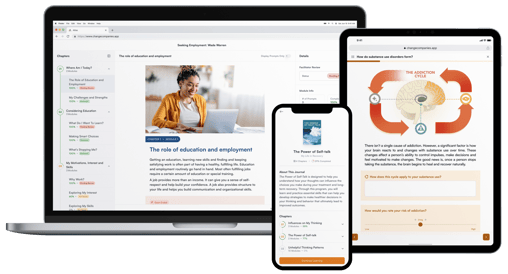
Person-centered, individualized skill-building resources are key to guiding clients toward successful outcomes in recovery. Our digital intervention platform,[Atlas](https://changecompanies.net/atlas), can help. Atlas delivers hundreds of topics related to addiction treatment, coping skills, and trauma education, allowing staff to tailor treatment to meet individual needs.
To learn more about Atlas and how it supports treatment organizations like yours,[download the Treatment Atlas Overview here](https://changecompanies.net/atlas/learn-more).
[](https://blog.changecompanies.net/hs/cta/wi/redirect?encryptedPayload=AVxigLLJjOwgAiGCb05PdzmuRDaEJl8wKjeMiTQyeTVHn4lrIcJx54F3zUIdlLqNzGDe42ca%2FU%2BGl%2BEAK5jz7Q9vGsg2qBBGbTJnMJU1WNJ4I3ybyHxdDUpouzwtSnungZTw3OznljPveiXf6NV0LPWgOR8kLIeH%2BuDv49xoM1N5PcOYNxAiwWdDHXr%2B9BDbRv7NLUrikkbzvJTn%2FTdnICA%3D&webInteractiveContentId=210836473477&portalId=20881724)
See how[Atlas](https://changecompanies.net/atlas) works for your agency → [Book a quick demo](https://changecompanies.net/atlas/demo)
---
[](https://changecompanies.net/atlas)
Evidence-based, behavioral health[Interactive Journaling®](https://changecompanies.net/interactive-journaling) curricula are available digitally on [Atlas](https://changecompanies.net/atlas). Atlas can save staff time while supporting fidelity to evidence-based practices.
**Ready to see what Atlas can do for your program?** Visit our website to schedule a personalized demo today. [Learn more about Atlas →](https://changecompanies.net/atlas/demo)
Provide your information below for a complete overview of [Atlas](https://changecompanies.net/atlas) for your setting.

#### The Change Companies
For over 30 years, The Change Companies has delivered cutting-edge behavior change tools to over 26 million individuals in addiction treatment and justice services. We combine the latest change research with end-user feedback to continually improve the design and delivery of innovative solutions, such as our evidence-based practice of Interactive Journaling®, our programming platform, Atlas, and our live and on-demand skills-based training programs.
[](https://changecompanies.net/)
Developing evidence-based solutions that help people make positive life changes.
##### Products
[Interactive Journaling®](https://changecompanies.net/interactive-journaling) [Atlas: Programming Platform](https://changecompanies.net/atlas?hsLang=en) [Clinical Assessments](https://shop.changecompanies.net/collections/clinical-assesments)
##### Solutions
[Behavioral Health](https://changecompanies.net/behavioral-health) [Community Corrections](https://changecompanies.net/community-corrections) [Correctional Institutions](https://changecompanies.net/prison-jail) [Opioid Abatement](https://changecompanies.net/opioid-abatement?hsLang=en) [Juvenile Justice](https://changecompanies.net/solutions-for-juvenile-justice?hsLang=en)
##### Login
[Atlas](https://changecompanies.app) [Store Account](https://shop.changecompanies.net/account) [eTraining](https://legacy.changecompanies.net/account/login.php) [Fidelity Platform](https://fidelity.changecompanies.net/login)
##### Support
[Submit a Ticket](https://go.changecompanies.net/bug-issue) [Technical Support](https://support.changecompanies.net/)
##### Resources
[Blog](https://blog.changecompanies.net/?hsLang=en) [Case Studies](https://changecompanies.net/case-studies) [Grant Support](https://changecompanies.net/grant-support?hsLang=en) [Webinars](https://changecompanies.net/webinars?hsLang=en) [Resource Center](https://changecompanies.net/resourcecenter) [Tips and Topics](https://changecompanies.net/tipsandtopics?hsLang=en)
##### Training
[Curriculum Training](https://changecompanies.net/training?hsLang=en) [Self-paced Learning](https://changecompanies.net/fidelity-platform?hsLang=en) [The ASAM Criteria](https://changecompanies.net/asam?hsLang=en)
##### Subscribe
Stay updated with our latest news and product releases.
[Subscribe to Updates](https://share.hsforms.com/1u_jrRk3sTyWSKk-Yalo2zQcfkfw)
##### Ready to learn more?
See how Atlas delivers behavior change for clients and AI-powered resources for staff.
[Book an Atlas Demo →](https://changecompanies.net/atlas/demo)
© 2026 The Change Companies. All rights reserved.
[Privacy Policy](https://changecompanies.net/privacy-policy) [Terms of Use](https://changecompanies.net/terms-of-use) [(888) 889-8866](tel:18888898866)
```json
{
"@context" : "https://schema.org",
"@type" : "BlogPosting",
"author" : {
"@type" : "Person",
"name" : "The Change Companies",
"url" : "https://blog.changecompanies.net/author/the-change-companies"
},
"dateModified" : "2026-08-06T18:17:10.527Z",
"datePublished" : "2026-08-04T17:30:00.000Z",
"headline" : "Why gender-responsive care matters in addiction treatment",
"image" : [ "https://blog.changecompanies.net/hubfs/Blog/Banner%20Graphics/Women%20in%20recovery%20(6).png" ],
"mainEntityOfPage" : {
"@id" : "https://blog.changecompanies.net/why-gender-responsive-care-matters-in-addiction-treatment",
"@type" : "WebPage"
},
"publisher" : {
"@type" : "Organization",
"logo" : {
"@type" : "ImageObject",
"url" : "https://blog.changecompanies.net/hubfs/TCClogo_website.png"
},
"name" : "The Change Companies"
}
}
```
```json
{
"@context" : "https://schema.org",
"@type" : "VideoObject",
"caption" : {
"@type" : "MediaObject",
"contentUrl" : "https://blog.changecompanies.net/media-transcripts/218623580050/en.vtt",
"inLanguage" : "en",
"name" : "en Captions"
},
"contentUrl" : "https://20881724.fs1.hubspotusercontent-na1.net/hubfs/20881724/video_assets/218623580050/inherited/web_optimized.mp4",
"dateModified" : "2026-08-03T16:57:19.745Z",
"duration" : "PT2M30S",
"height" : 1080,
"name" : "Women-in-Recovery-Updated-Edit",
"thumbnailUrl" : "https://changecompanies.net/hubfs/Videos/Curriculum%20Tours/Women-in-Recovery%20overview.mp4/medium.jpg",
"uploadDate" : "2026-08-03T16:56:50.113Z",
"width" : 1920
}
```