


Whatever side of the political aisle you sit on, there is consensus that the recent national midterm election results shook up a lot of long-held beliefs about how people in what states vote in which way. Dr. Joan M. Cook, who is a trauma psychologist and a professor in the Psychiatry Department at the Yale School of Medicine, recently wrote an article in TIME magazine on “How to Keep an Open Mind.”
Cook wrote: “It’s easy to think we are right, and someone else’s perceptions and ways of being are wrong. But the tighter we clench our jaws and fists, the more we restrict our ability to connect and expand both our views and our connections.”
Dr. Cook explained that open-mindedness is related to intellectual humility, recognizing one’s own imperfections as a knower, and appreciating others’ thinking strengths.
Those who recognize that their beliefs or opinions may be fallible or incomplete are often more willing to learn about others’ views. Research shows taking in new information helps us:
-
Widen our knowledge base
-
Increase creativity and psychological well-being
-
Enhance professional development
-
Facilitate empathy
-
Improve relationships
-
Widen social networks
When we only stay within our comfortable social media algorithms and tight in-person circles:
-
We can get stuck in echo chambers, reinforcing what we already think we know.
-
While this can provide identity and a sense of belonging, it can limit our exposure to new experiences.
It is in our best interest to:
-
Be willing to listen to different points of view
-
Fully hear someone else’s perspective
-
Resist flinging verdicts on others’ intellect or integrity or viewing them as uninformed and biased
Approaches for strengthening open-mindedness
If we simply hear what other people have to say but have no intention of expanding our hearts and minds, then we remain entrenched and defended. That’s not openness.
So how do we strengthen our ability to be open-minded?
-
Increase what psychologists call our “latitude of acceptance,” meaning a willingness to non-defensively consider ideas that others hold. Doing so does not guarantee we are going to change our minds, but it does show that we are ready to listen and consider others’ perspectives.
-
Awareness training: teach people about cognitive biases, for example confirmation bias, which is the inclination for people to trust too much in their preferred assumptions and to take in new information that fits their existing beliefs.
-
Run perspective-taking interventions where one tries to imagine another person’s experiences and why they might think in a certain way. This can be enhanced by viewing a picture, video, or recording of the other person or using virtual reality technology to powerfully see their perspective.
These strategies seem to work particularly well when we meet another person and share our perspectives on their thinking.
Another powerful tool is perspective-getting, which involves non-confrontationally asking another to share their outlooks. People can learn to develop skills to navigate difficult conversations by:
-
Engaging face-to-face rather than side by side
-
Asking open-ended, curious questions
-
Using receptive language, such as expressing uncertainty, acknowledging mistakes, and finding points of agreement.
Of course, these interventions don’t always work and can backfire, making some even more entrenched in their beliefs.
-
While it is in our best interest to consider others’ beliefs, this is not always the case.
-
Some views may go deeply against our core values, and that’s okay if we choose not to bend on those.
-
But we can still benefit from being gracious and respectful toward others.
A willingness to consider others’ perspectives can be difficult in general, and particularly hard when the subject at hand is something that is near and dear to our hearts, such as religion and politics.
If we are willing and motivated to practice being more open-minded, and if we want to set ourselves up for success, it might be easier to pick topics where we feel less defensive:
-
Are dogs or cats better companions?
-
Is it more enjoyable to watch a newly released film at home or in the cinema?
-
Are you for or against pineapple on pizza?
These topics may sound silly, but they invite dialogue and healthy conversation and disagreement.
Setting aside assumptions and staying aware of biases
Cook asked Dr. Damion Grasso, a professor of psychiatry at the University of Connecticut, how he practices being open-minded in both his professional and personal life. In working with trauma-exposed youth and families, he said, “Open-mindedness is essential. It helps me set aside assumptions, stay aware of my own biases, and create a therapeutic space where young people and caregivers feel heard, respected, and actively involved in the process of change.”
Imagine our workplaces, home life, and neighborhoods engaged in being more curious, reflective, and respectful. With an open-minded perspective, we could learn and accomplish many things together.
Read the entire November blog on David Mee-Lee's Tips & Topics here →
Authored by Dr. David Mee-Lee, “Tips & Topics” is a monthly blog covering three sections: Savvy, Skills and Soul, with additional sections varying from month to month. Topics include Stump the Shrink, Success Stories and Shameless Selling.
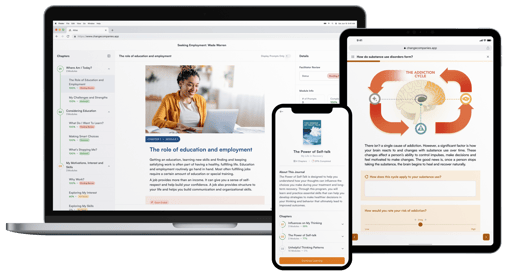
Evidence-based, behavioral health Interactive Journaling® curricula are available digitally on Atlas. Atlas can save staff time while supporting fidelity to evidence-based practices.
Ready to see what Atlas can do for your program? Visit our website to schedule a personalized demo today. Learn more about Atlas →
Fill the form to learn how Atlas accesses the journals and use these tools to improve staff efficiency: